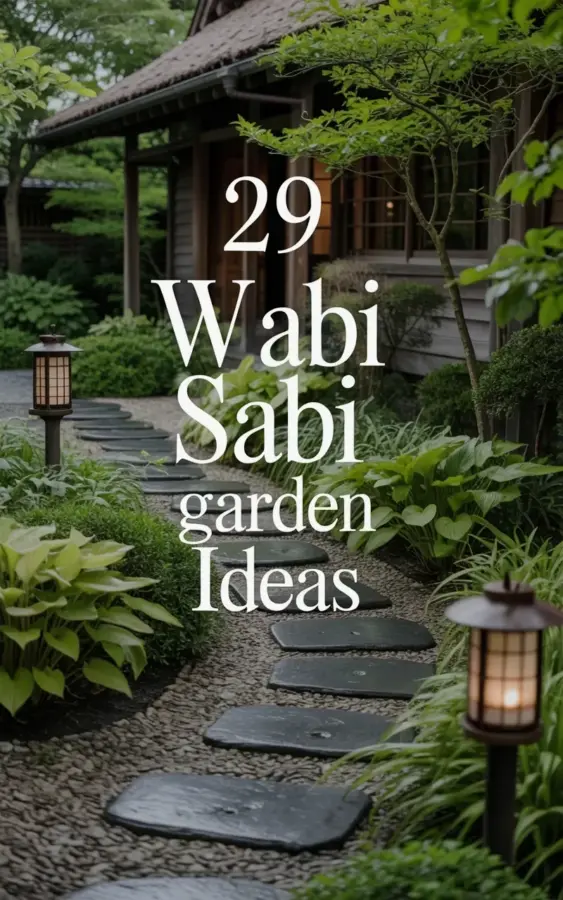
Walking a garden path should feel like a quiet exhale, not a march in formation. But if you’re planning a wabi sabi garden and you lay your stepping stones in a ruler-straight line, you’ve already missed the point. Honestly, that’s the one mistake I see over and over in landscape design, and it completely kills the zen vibe you’re after. The glorious photo we’re imagining here, a winding ribbon of dark gray stones cutting through lush greenery with warm lanterns glowing around a weathered wooden structure, gets it exactly right. It’s that curated imperfection, that sense of natural flow, that makes a garden path feel like it’s been there for a hundred years.
Why Straight Lines Break the Wabi Sabi Garden Spell
Look, straight lines are for driveways and formal French parterres. They have no business in a Japanese-inspired stroll garden. When you force a path into a stiff, geometric line, your eye skips straight to the end. You lose all the mystery and all the pauses. Nothing invites you to slow down like a path that disappears around a corner, hiding what comes next.
There’s a psychological shift when a path curves. Your brain registers it as a journey, not a chore. You start to notice the moss creeping over the stone edge before the bend. You hear the tiny gravel shift under your shoe. A curved path prolongs the moment, which is the entire point of a zen garden. It’s not about reaching a destination; it’s about the walk itself.
The Number One Path Mistake: Obsessing Over Perfect Alignment
Here’s the thing, we are conditioned to build in straight lines because it’s easier, we can pull a taut string between stakes and bang out the layout in twenty minutes. But wabi sabi demands you throw that string away. The beauty lies in the slight offset, the awkward gap, the stone that sits just a little bit lower than its neighbor. That’real, and it’s beautiful.
Please don’t measure your spacing with a ruler. There is no grid in nature. In the photo that this article is based on, you can feel the organic rhythm of those dark gray stepping stones. Each one is placed to accommodate a natural stride, not a mathematical formula. That’s what separates a sterile walkway from a genuine zen path.
So, how do you shake the urge to make everything even? You fight the symmetry by working with the land. Don’t flatten the ground entirely to fit the path. Let the path follow the contours of your yard. If there’s a slight rise, let the stones step up naturally. If there’s a wet spot, route around it. The path should look like it discovered the garden, not like it conquered it.
How to Use Gravel and Stepping Stones to Create Flow
Ok so, gravel is your best friend here. It’s loose, it’s forgiving, and it makes that wonderful crunching sound that instantly calms you down. In our featured image, the light-colored gravel contrasts beautifully with the dark stone slabs, and that contrast is crucial. It defines the space without creating a hard, artificial boundary.
When you lay stepping stones, bed them deeply. You want the top of the stone to be just about level with the gravel, or maybe a fraction of an inch above. A stone that is perpetually loose and rocking underfoot is a tripping hazard and a nuisance. Set them firmly in a sand or crushed rock base, then sweep the gravel around them. Later, some gravel will inevitably scatter onto the stones. Leave it. That scattered debris is literally the wabi sabi aesthetic doing its job.
Here are a few quick tips for nailing that natural flow:
- Vary the distances between stones, sometimes a short hop, sometimes a long stride.
- Avoid using perfectly round or square pavers, the irregular, chunky shapes are better.
- Let the path narrow as it goes into the foliage, it creates a sense of compression and release.
- Use larger stones at the start and end of the path to anchor the transition.
If you do this right, the path won’t look “installed.” It will look like it grew there, which is the highest compliment you can give a landscape.
Lanterns and Lighting: Setting the Mood Along Your Zen Path
Now, let’s talk about the lanterns. In the picture we’re referencing, there are two traditional black metal lanterns, one on the left and one on the right, casting a warm, inviting glow. This is not an afterthought. That lighting setup is the heartbeat of the evening garden. It’s what draws you outside after dusk and keeps you lingering.
You don’t need to flood the path with harsh light. In fact, you want the opposite. You want pools of light that hint at the edges of the path while leaving the rest of the garden in a gentle, shadowy mystery. Place your lanterns on the outside of the curves, not on the straight sections. This draws the eye around the bend and encourages exploration.
Solar lights are fine, they are easy to install and energy-efficient, but they rarely have the soul of a wired, low-voltage system with warmer bulbs. The color temperature matters too. We are aiming for a soft amber glow, not the sterile blue-white of a security light. I have a mild obsession with those antique-style lanterns, they look brilliant even in daylight when they’re tucked under a maple tree. Don’t be afraid to place them low, near the ground, so they illuminate the texture of the gravel and the moss.
Embracing Imperfection and the “Worn” Look
The wabi sabi garden is not about polished perfection, it’s about the beauty of things imperfect, impermanent, and incomplete. This means you should actively encourage signs of age and weather. Let the wood on your gate gray out naturally. Let the lichen take hold on the stones. That patina is priceless and it can’t be bought from a catalog.
I remember visiting a temple in Kyoto where the stone path was so worn down in the center that it had formed shallow dips, polished by decades of wooden geta sandals. It was one of the most gorgeous, humbling things I’ve ever seen. You can’t fake that with a grinder. You can only create the conditions for it to happen over time by choosing materials that age well and then leaving them alone. It’s called a “stroll garden” for a reason; the whole point is to let time do its thing.
So, here’s my pleading for the garden, stop fighting the elements. Don’t pressure-wash the path until it looks like the day it was poured. Don’t prune your shrubs into perfect spheres. Let them reach for the light in quirky shapes. The asymmetry is what creates the emotional connection. If everything in your garden is perfect, there is nothing for your eye to rest on, and the space becomes sterile rather than serene.
Choosing Plants That Complement the Natural Flow
The luscious green foliage in the photograph isn’t there by accident. Those dense, layered plants are what soften the hard edges of the stones and create that cozy, tucked-away feeling. You want to use a mix of textures, think broad hosta leaves next to feathery ferns, and the spiky structure of an iris poking up through the background.
Native plants are usually the best choice for a low-maintenance Japanese garden aesthetic. They are already adapted to your climate, so they’ll look lush without requiring a ton of water or fertilizer. Consider adding moss as a ground cover. It thrives in the shade and provides that eternal, ancient feel that is so synonymous with Zen spaces. It’s soft, it’s green, and it absolutely adores growing in the gaps between gravel and stone.
One technical note, make sure you don’t let the plantings choke the path. If the hostas spread too far, they’ll cover the stepping stones and force you to shuffle through wet leaves in the morning, which is annoying. Trim them back ruthlessly in early spring so they read as a soft frame, not a wall.
Creating a wabi sabi garden is a process of unlearning. You have to unlearn the symmetry, the perfection, and the control that modern landscaping pushes on us. Replace that with a sense of discovery and a deep respect for natural entropy. Go on, take a walk on your new path. Feel the irregular stones beneath your feet, listen to the gravel, and watch the lanterns flicker on as dusk settles. That’s the whole ballgame right there. If you’re planning a garden renovation soon, I’d love to hear what curve you’re putting in, send me your sketches on Pinterest for some inspiration.
#wabisabigarden #japanesegarden #zenpath #gardenpath #landscaping
Leave a Comment