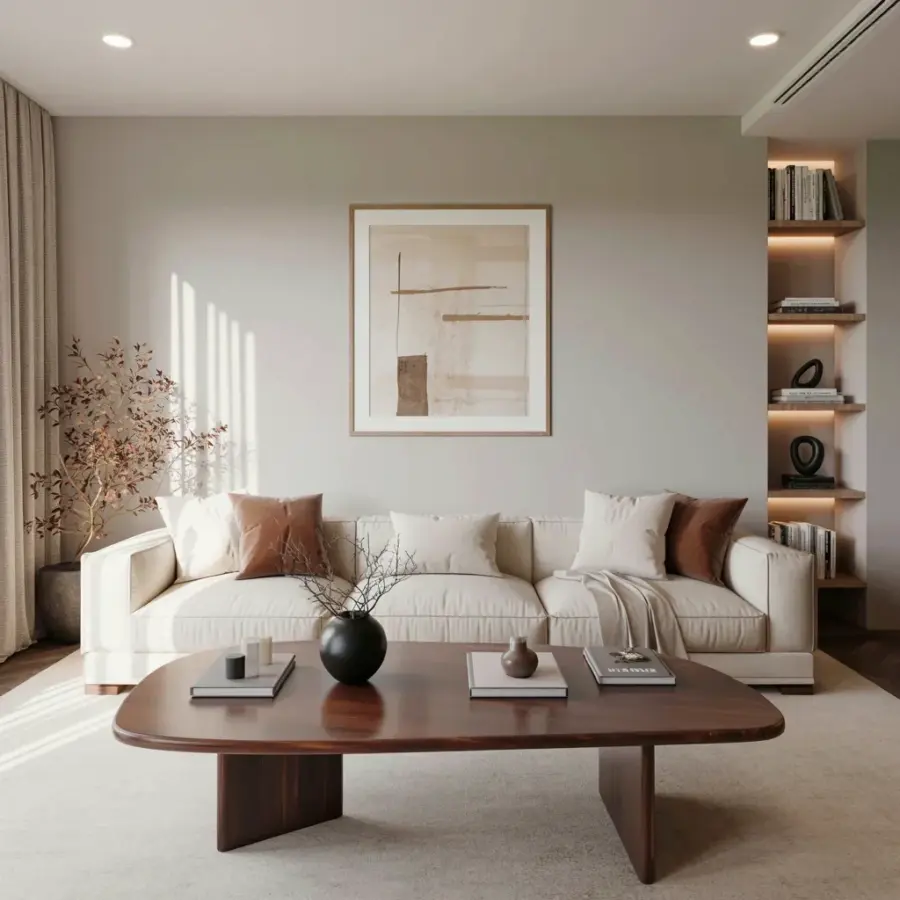
That matching set you bought? It’s the exact reason your minimalist room feels less like a serene retreat and more like a hotel lobby. I see it all the time in otherwise lovely homes, and honestly, it breaks my heart a little. The furniture is fine, the colors are fine, but the soul is missing because everything came from the same glossy catalog page.
Look, minimalism gets blamed for being cold a lot. But the coldness rarely comes from having fewer things. It comes from having too many things that don’t talk to each other. A room where every piece shares the exact same finish, the exact same fabric, and the exact same design era is a room without history. It’s a showroom.
## Why Buying a Full Matching Set Kills the Warmth
When you buy a full living room set, you’re telling the story of a furniture store, not the story of your life. That matching sofa, loveseat, and recliner combo might look impressive in the warehouse, but in your actual home, it flattens all the visual texture. It leaves no room for a piece that has a scratch on the armrest or a cushion that sinks in the exact shape of your body.
The human brain craves contrast. We need a little roughness next to smoothness, a little dark next to light, a little old next to new. Without those differences, the space becomes monotonous. And monotony feels cold because it feels untouched. Nobody lives in a furniture ad.
Buying in sets also means you get the same level of comfort everywhere. That sounds fine, but it eliminates the eco-system of a room. You want a chair for reading that hugs you tight, and a sofa for movie nights that lets you sprawl. A matching set usually gives you one type of seat, repeated three times. It’s efficient, sure. But it’s also boring.
## The Right Ratio to Make Minimalist Home Decor Feel Lived-In
Here’s the thing: you don’t have to quit matching sets cold turkey. The trick is to break the symmetry on purpose. I’ve found that keeping just two matching pieces in a room is enough to anchor the space. A sofa and a matching armchair, fine. Two matching end tables, great. But the third, fourth, and fifth pieces need to be outsiders.
Aim for a ratio of about 30% matched and 70% mismatched. That sounds like a lot of work, but it’s actually easier than you think. Start with a neutral sofa, then add a different chair. Add a coffee table that has a totally different shape or materiality than the sofa frame. The goal is to create little visual conversations between the pieces. A sleek modern sofa next to a rustic wood stool looks intentional. It looks like a human made a choice, not like a robot downloaded a catalog.
## Swap the Matching Recliner for a Worn Leather Chair
If you have a beige fabric recliner from the same set as your beige fabric sofa, swap it out immediately. No, seriously, I mean it. Look for a leather chair that already has some miles on it instead. The kind with cracked arms and a patina that took a decade to develop. That chair has a voice. It whispers about long afternoons and spilled coffee and naps in the sun.
This is the single easiest way to add warmth to a minimalist room. Leather ages beautifully, but it doesn’t age alone. It ages with you. A worn leather chair brings a deep, rich tone that breaks up the monotony of light neutrals. It adds a darker accent without you having to paint a wall or buy a new rug. And when you catch a whiff of that old leather smell, the whole room instantly feels more grounded. Honestly, nobody ever walked into a waiting room and said, “Wow, this smells like a cozy den.”
## Layering Chunky Knit Throws and Natural Textures
Ok so you’ve mixed up the furniture, but the room still feels a bit stark. That’s usually a fabric problem. Minimalist rooms often use flat, tight weaves for everything, which bounces the light around without absorbing any of it. You need surfaces that catch the air. You need a chunky knit throw.
Drape a thick, cable-knit blanket over the back of a chair. It doesn’t have to be perfectly folded. In fact, the messier it hangs, the better it looks. The uneven loops undulate and create shadows that make the eye slow down. Pair that with some textured cushions, maybe a boucle or a nubby wool, and suddenly the room feels tactile. You want to reach out and touch things. That’s the opposite of a cold waiting room.
Don’t stop at textiles either. Bring in natural materials that have an irregular surface. A rough-edged wooden bowl on a coffee table. A stone vase holding a few dried grasses. A woven jute rug underneath your feet. These items don’t scream for attention, they just make the air feel warmer. They remind you that the space isn’t sterile. It’s alive.
## Mixing Wood Tones Without Looking Chaotic
Lots of people think minimalist decor demands that all the wood in a room matches. That’s a limiting belief, and you should drop it. You can absolutely mix a light oak coffee table with a dark walnut media console. The trick is to choose a dominant tone and then use the others as accents. Let’ say you have a lot of medium oak in the room. Make that your base, and then introduce just one or two dark walnut pieces to add weight and depth.
The various woods don’t need to match each other. They just need to both look natural. If one piece is bright orange pine and the other is gray-stained ash, you’ll feel the clash immediately. But if you stick to woods that have a similar amount of red or brown in their undertones, you can mix them freely. The visual inconsistency is what gives the room personality. It looks like you collected things over time. It looks like a home with minimalism mistakes avoided.
To keep it from feeling chaotic, group similar tones together. Put all the lighter woods on one side of the room and the darker ones on the other. Create a central bridge, like a rug or a sofa, to ease the transition. It’s a balance, not a match. That’s the most important lesson for anyone wanting to master neutral home style without the sterile vibe.
## What To Buy Instead of a Matching Set (On the Budget)
You don’t need to overhaul everything at once. Start with one swap, maybe the side table or the accent chair. Worried about the budget? Here are a few practical swaps that are all easier on the wallet than you think:
– **Check the damaged section of big box stores.** A scratched chair or a dented table is often discounted 30 to 40 percent.
– **Hit up local thrift stores and flea markets for a single solid wood piece.** Look for heavy, solid construction and ignore the awful finish, paint or sand it down.
– **Buy a used leather chair from a consignment shop.** The older it is, the more character it has, and the cheaper it tends to be.
– **Avoid new matching sofa and loveseat pairs entirely.** Buy one great sofa, then hunt for a unique secondhand armchair instead.
– **Splurge on texture, not on furniture.** A $50 chunky knit throw can do more for a room’s warmth than a $2,000 new sofa.
Look, a minimalist room should feel like a deep breath. It shouldn’t feel like a deep breath in a sterile laboratory. The goal is to strip away the noise, not to strip away the personality. Keep your lines clean. Keep your color palette calm. But let the objects themselves have a little history.
## How to Style What You Already Own
Before you rush out to buy new stuff, try shifting what you already have. Move the armchair from the corner and place it at an angle facing the sofa. That small change creates a more conversational layout and breaks up the linear, showroom feel. Switch out the lamp shades or change the placement of your art to bring the eye up. Sometimes the problem isn’t the furniture, it’s the rigid way it’s arranged.
You can also change the hardware on a cheap dresser or switch the legs on a flat, boring sofa. I once replaced the squat, black plastic legs on a bargain sofa with some tapered walnut legs I found online for twenty bucks. The entire piece looked expensive after that. The height change made it feel lighter and more tailored. Small tweaks like this can transform a room without you having to explain to your partner why you just dropped a grand on a chair.
And here’s a little hyper-specific thing I always recommend: leave something slightly imperfect on display. A stack of books with spines that have faded at different rates. A bowl of pinecones gathered from a specific hike. A ceramic mug that has a glaze drip that didn’t quite make it down the side. These little imperfections are the fingerprints of a real life. They are the opposite of a perfect, plastic showroom. They are what make minimalism feel human.
Creating a warm minimalist space is less about buying the “right” items and more about buying with intention. Resist the urge to buy everything at once. Let the room develop over months or even years. Let one piece lead to the next based on how you actually live, not based on how an Instagram grid tells you to live.
I’d love to hear what piece in your living room has the most history behind it. Is it that old leather recliner from your grandpa, or that thrifted coffee table you almost left behind? Go look at your space with fresh eyes and see which one brings the warmth. Then save this post for your next redo and start hunting for that one imperfect, perfect piece to add to your story.
Leave a Comment