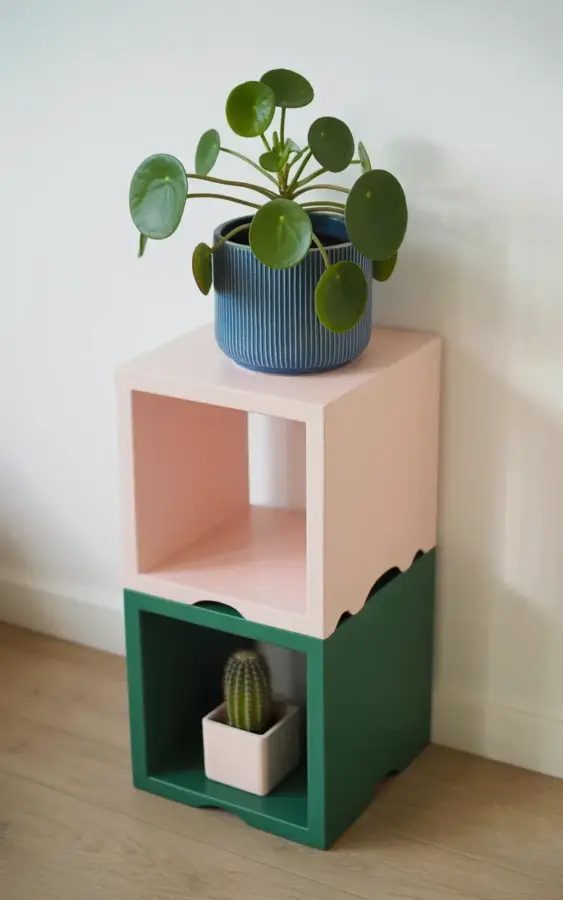
Three tiers, three distinct vibes, and one very specific color story. That geometric plant shelf in the photo, the one with the pink top and forest green base, is the kind of piece that makes you rethink everything you thought you knew about plant display. It’s not just a place to dump your pots and call it a day. It’s a sculptural object in its own right, and the way it breaks the rules of symmetry while still feeling completely intentional? That’s the magic. If you’re here hunting for ideas on how to style a geometric shelf unit, you’re in the right spot. Let’s talk about what makes this particular setup work so well, and how to steal the concept for your own space.
This whole look is deceptively simple. Against a clean white wall, the blocky shapes of the shelf pop without screaming for attention. You have a light pink top tier, a middle pink tier that’s just sitting there looking calm, and then a darker forest green bottom that anchors the whole unit. It’s playful but not childish. Mature but not boring. And honestly, the more I look at these minimalist plant shelves, the more I think the secret isn’t the plants at all. It’s the composition. The negative space. The willingness to let a shelf just be a shelf instead of cramming it with knickknacks.
## Why the Pink and Green Combo Works So Well for Plant Decor
Here’s the thing about color. Most people default to all-white or all-wood shelving because it feels safe. And sure, it is safe, but it’s also a little predictable. The second you introduce a pastel pink block and a deep forest green base, the furniture stops being just furniture. It becomes the aesthetic anchor for the entire room.
Pink and green are complementary colors, but not in the loud, high-contrast way you see in holiday decorations. The pink here is soft, almost like a blush paper bag. The green is moody, like a shaded forest floor. They balance each other. The Pilea leaves pick up the green from the bottom shelf, and the ceramic pot ties into the dark blue accents. It’s a full circle moment. There’s a cohesion to this palette that makes the whole arrangement feel like it was designed in a studio, not thrown together in a living room. If you want to replicate this, don’t just buy the shelf. Commit to the color story and let every item on it play a supporting role.
## The Pilea Peperomioides Star of the Show
Let’s talk about that plant on the top tier. Pilea peperomioides, also called the Chinese money plant or the pancake plant, is having a serious moment right now, and honestly, it deserves every bit of the hype. Those round, glossy leaves look printed on. The stems are tall and delicate, but they hold the leaves up like little green plates. On this particular shelf, the Pilea sits in a dark blue pinstriped ceramic planter, which is a tiny detail that adds a lot of texture to the clean lines of the pink block.
The Pilea is not a diva. She likes bright, indirect light, which makes her perfect for a white-walled room with windows that aren’t directly blasting the wall. Let the soil dry out almost completely between waterings. You’ll know she’s thirsty when the leaves start to droop a little, and honestly, they bounce back within hours of a good drink. Think of her as the reliable friend who shows up, looks great, and doesn’t ask for much. She’s the visual anchor here, the one that draws your eye up. Without her, the top pink platform would just be a storage block. With her, it’s a throne.
## How to Style a Minimalist Plant Shelf Without Cluttering It
Alright, let’s get practical. The biggest mistake people make with these geometric shelves is overcrowding. You see the shape, you get excited, and then you buy ten tiny plants to fill every single surface. Stop. Look at the photo again. The middle tier is completely empty. That’s not an oversight, it’s a choice. The negative space gives the eye a place to rest.
Here are a few rules I swear by when styling a minimalist plant shelf:
– Choose plants with different textures: one with round flat leaves, one spiky like a cactus, one trailing. Mixing the leaf shape is what creates visual interest.
– Use planters that have their own personality: the dark blue pinstripes are doing just as much work as the plants themselves.
– Leave at least one bare section on the shelf. Let the structure of the shelf speak for itself.
– Vary the pot heights. Put something on a small wooden riser or a stack of books if you want the layout to feel dimensional.
Less really is more. A minimalist plant shelf is about curation, not collection. If you have room for four plants, consider buying three and letting the fourth space just exist. The pause is part of the design. It’s like the rest in a song, you don’t always notice it, but you absolutely feel when it’s missing.
## Mixing Terracotta, Ceramic, and Cactus Planters for Contrast
The bottom tier of this unit is where things get a little darker and a little more grounded. Forest green is an undervalued neutral. It reads like a natural shadow, and it provides the perfect backdrop for a small potted cactus. You don’t need a huge saguaro here. A small, round cactus, slightly chunky, a little bit awkward, is exactly the right energy.
What I love about this section is the tactile variety. You have the painted wood of the shelf, the matte or glazed ceramic of the pots, the smooth skin of the cactus itself. Throwing in different materials keeps the display from feeling like a store display. Put the cactus in a small terracotta pot if you want to keep it earthy, or use a baggy ceramic container if you want it to feel more contemporary. Since cacti are slow growers, they won’t outgrow their space quickly. That means your composition will look the same in six months, which is kind of comforting in a world where everything else changes too fast.
## Making a Statement With a White Wall and Light Wood Floor
The background of this little scene is doing way more than people give it credit for. White walls are the best canvas, an empty gallery wall just waiting for you to hang something interesting on it. Then you add light wood floors, which bring warmth without dominating. Together, they create an environment where the pink and forest green shelf can really shine.
Here’s the thing about staging: you don’t need an expensive renovation to make a geometric shelf unit look high-end. The bright white wall acts like a professional photo lightbox. It reflects the sunlight, casts soft shadows, and makes every color on the shelf look more saturated. If your walls are beige or grey, consider painting just the one wall white before you buy a statement shelf. It’s a cheat code, honestly. Light floors amplify the effect because they bounce light back up onto the lower tier. This photo could have been taken in an apartment, a studio, or a tiny house, and the setup would still feel deliberate.
## Where to Put This Geometric Shelf Unit in Your Home
Ok so the photo shows it in what looks like a living area, but this exact shelf could work in several spots. You just have to think about the sightlines. Place it near a window where the plants get some morning sun, but avoid direct afternoon rays that can scorch the Pilea leaves. In a hallway, it becomes the first thing you see when you walk in. A bare bedroom corner works too, but you might want to swap the cactus for a low-light tolerant plant like a snake plant or a ZZ if the room doesn’t get much natural light.
I’ll tell you a secret about my own setup: I have a similar shelf in my bathroom of all places. It’s weird, right? But steam from the shower is actually great for tropical houseplants, and the geometric shelf adds a little spa energy to an otherwise boring room. Just sayin, don’t limit yourself to the living room. A shelf this versatile will adapt to wherever you put it, as long as you pay attention to the light requirements of the plants you choose.
## Cactus Care 101 and Pilea Maintenance on a Shelf
Taking care of the specific plants in the photo isn’t hard, but it does require a different mindset for each one. The Pilea, as I said, likes to dry out between waterings. Pop your finger in the soil. If it’s dry up to your second knuckle, water it thoroughly. The cactus on the bottom is even lower maintenance. Water it every three to four weeks in the summer and maybe once a month or less in the winter. They literally want to be forgotten for a bit. That’s not neglect, that’s love.
One thing to watch out for on a shelf is dust. The leaves of a Pilea are large and round, and dust loves to settle on them. Wipe them down with a damp cloth every few weeks. The cactus gathers dust differently, usually on the ribs of the plant, but a gentle brush or a puff of air from a straw works fine. Keep them out of the path of direct heating vents, because dry hot air blasting a Pilea will cause the edges to crisp up. Nobody wants crispy leaves. And if you notice the Pilea leaning towards one side, rotate the pot a quarter turn every time you water. That will keep the shape symmetrical as it grows.
So here’s the thing, this geometric shelf unit is more than just a place to put a plant. It’s a mood. A statement. A tiny green and pink sculpture that gives you an excuse to look at it every time you walk past. The Pilea gives it life, the cactus gives it structure, and the empty middle tier gives it room to breathe. Whether you copy this exact layout or use it as a springboard for your own plant decor, the important part is to have fun with it. Play with the colors, move the plants around, and find what makes you smile. And when you finally get it all set up just right, you know what? Send a picture of it up to Instagram or save it to your own Pinterest board, because good plant styling deserves to be shared. Happy decorating.
Leave a Comment